Most self-defense training focuses entirely on what happens during a fight. We spend hours at the range practicing draw strokes, managing recoil, and clearing malfunctions.
But if you are forced to draw your firearm, it means you are already in a reactionary gap. You are playing catch-up against an adversary who chose the time, place, and method of attack.
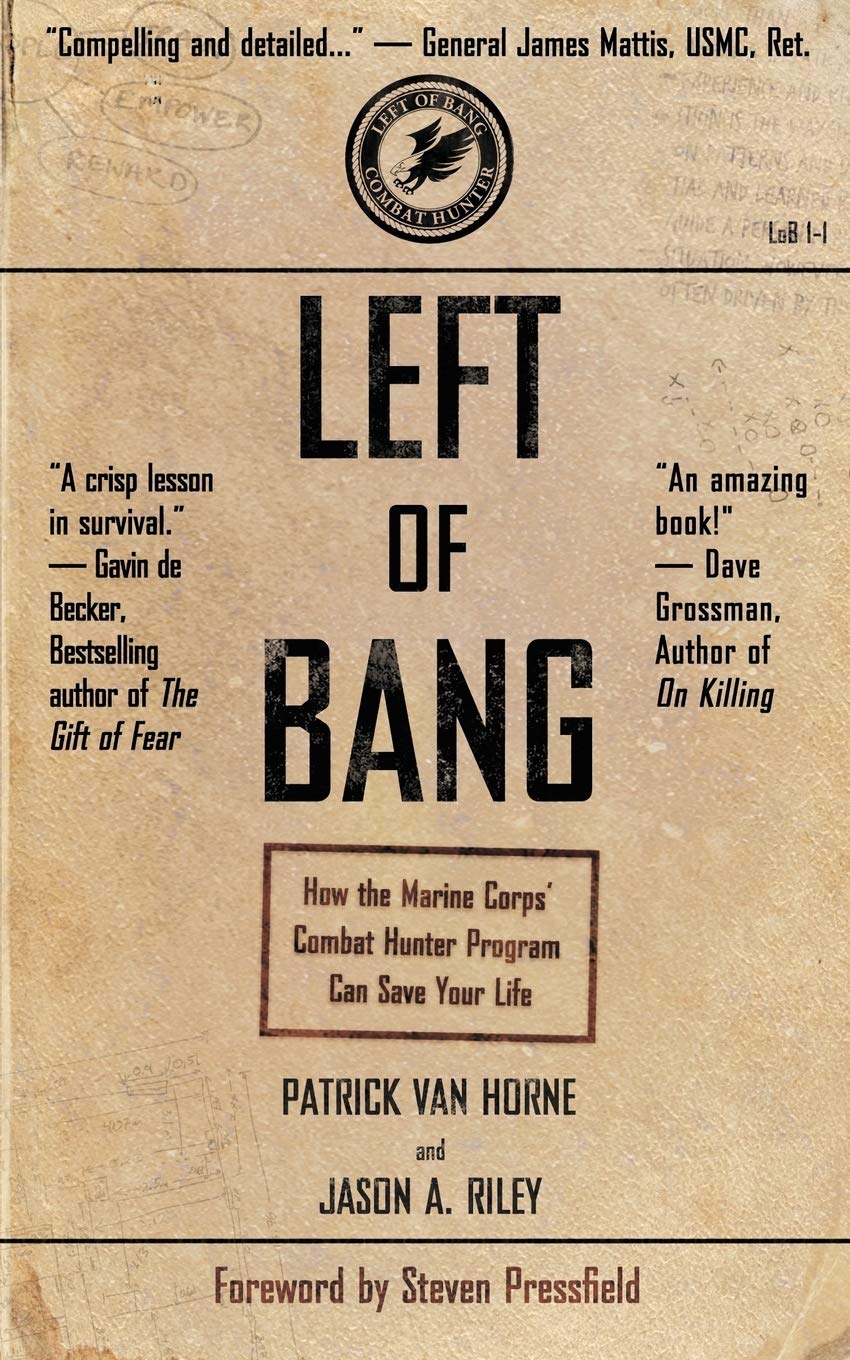
In their book Left of Bang: How the Marine Corps’ Combat Hunter Program Can Save Your Life, authors Patrick Van Horne and Jason A. Riley argue that the best way to win a fight is to recognize it’s happening before the first punch is thrown or shot is fired.
Though written for Marines, this tactical framework is one of the most valuable tools a concealed carrier can possess. Here is how to apply the principles of Left of Bang to your daily civilian carry routine.
1. The Timeline: Understanding “Left of Bang”
To understand the book’s core premise, picture a timeline running from left to right. In the middle of that timeline is “The Bang.”
- The Bang is the negative event: the ambush, the carjacking, the armed robbery.
- Right of Bang is everything that happens after. It is reactive, chaotic, and dangerous. If you are drawing your gun Right of Bang, you are already in deep trouble.
- Left of Bang is the window of time before the event occurs. This is where the indicators are present. Your goal as a concealed carrier is to live entirely “Left of Bang,” giving yourself the time and space to make a proactive decision—usually, to leave.
The takeaway: The “Bang” is your absolute deadline. If you aren’t actively searching for pre-assault indicators before it happens, you’ve already yielded the tactical advantage.
2. The Operational Framework: The Combat Hunter Pillars
The Combat Hunter program relies on breaking human behavior and environments down into structured data points. Instead of relying on a vague “gut feeling,” the book teaches you to look for specific cues across several pillars:
Establish a Baseline
You cannot identify an anomaly if you don’t know what “normal” looks like. Every environment has a baseline. The baseline of a quiet suburban coffee shop is vastly different from a chaotic downtown subway station. Before you can spot a threat, you have to look around and define the collective agreement of how people behave in that specific space.
Kinesics (Human Movement)
People who are hiding weapons, planning an attack, or experiencing intense adrenaline “leak” their intentions through body language. Watch for shifting weight, hyper-vigilance (scanning for cameras or police), hands hovering near the waistline, or “unconscious grooming” (touching or adjusting a concealed weapon).
Proxemics (Spatial Awareness)
Distance equals reaction time. Predators rely on closing the distance between themselves and their prey before launching an attack. Pay attention to how people occupy space. Is someone moving toward you at an angle that cuts off your exit? Are they ignoring social boundaries to get closer to you?
Geographics (Environmental Cues)
Predators leverage the physical environment to their advantage. They look for “anchor points” (places to blend in while observing targets) and transitional spaces (dark alleys, parking garages, stairwells) where you are vulnerable. Conversely, you should constantly map the geography for cover, concealment, and escape routes.
Iconography (Clothing and Symbols)
People broadcast who they are through what they wear, their tattoos, and their gear. While a specific style of clothing isn’t definitive proof of a threat, it provides valuable data. For example, someone wearing a heavy coat on a hot summer day isn’t just a fashion anomaly—they are likely concealing something bulky.
3. The OODA Loop on Steroids
You might already be familiar with Colonel John Boyd’s OODA Loop (Observe, Orient, Decide, Act). It’s the mental cycle we go through during a tactical situation.

When you master the pillars of Left of Bang, you drastically accelerate this process. Because you are actively reading the baseline and scanning for kinesic or geographic anomalies, you Orient to a threat seconds before anyone else. This compresses your decision-making time, allowing you to Act (evacuate, seek cover, or prepare to defend yourself) while the threat is still trying to figure out how to approach you.
Put it Into Practice: 3 Daily Drills
Reading theory is fine, but situational awareness is a perishable muscle. Use these three low-signature drills to build your “Combat Hunter” mindset without looking paranoid to the outside world.
- Exercise 1: The 30-Second Baseline
- Whenever you step into a new environment—a gym, a restaurant, a gas station—pause for 30 seconds. Look at the people and the atmosphere. What is the collective mood? Who belongs here, and what are they doing? Define the “norm” immediately.
- Exercise 2: Hunt for the Anomaly
- Once you have the baseline, actively look for the one thing or person that doesn’t fit. It doesn’t have to be a threat. It could be someone wearing business casual in a beachside diner, or someone who is visibly angrier than the environment dictates. Identify them and ask yourself why they stand out. This trains your brain to separate signal from noise.
- Exercise 3: Mindful Pathfinding
- When walking through crowds or busy areas, practice maintaining your “proxemic buffer.” If you spot someone whose body language or positioning makes you uneasy, subtly alter your path. Can you maintain a 10-foot boundary? Do you know where the nearest exit or solid cover is at this exact second?
Final Thoughts
A firearm is a tool of last resort. It is what you use when all your other systems have failed.
By shifting your mindset from surviving the bang to preventing the bang, you elevate yourself from a standard gun-owner to a truly prepared citizen. Pick up a copy of Left of Bang—it might just be the most important piece of self-defense gear you ever invest in.
Train hard. Train smart. Train safe.
AI assisted research and editing. Human verified and finalized.
Leave a Reply