
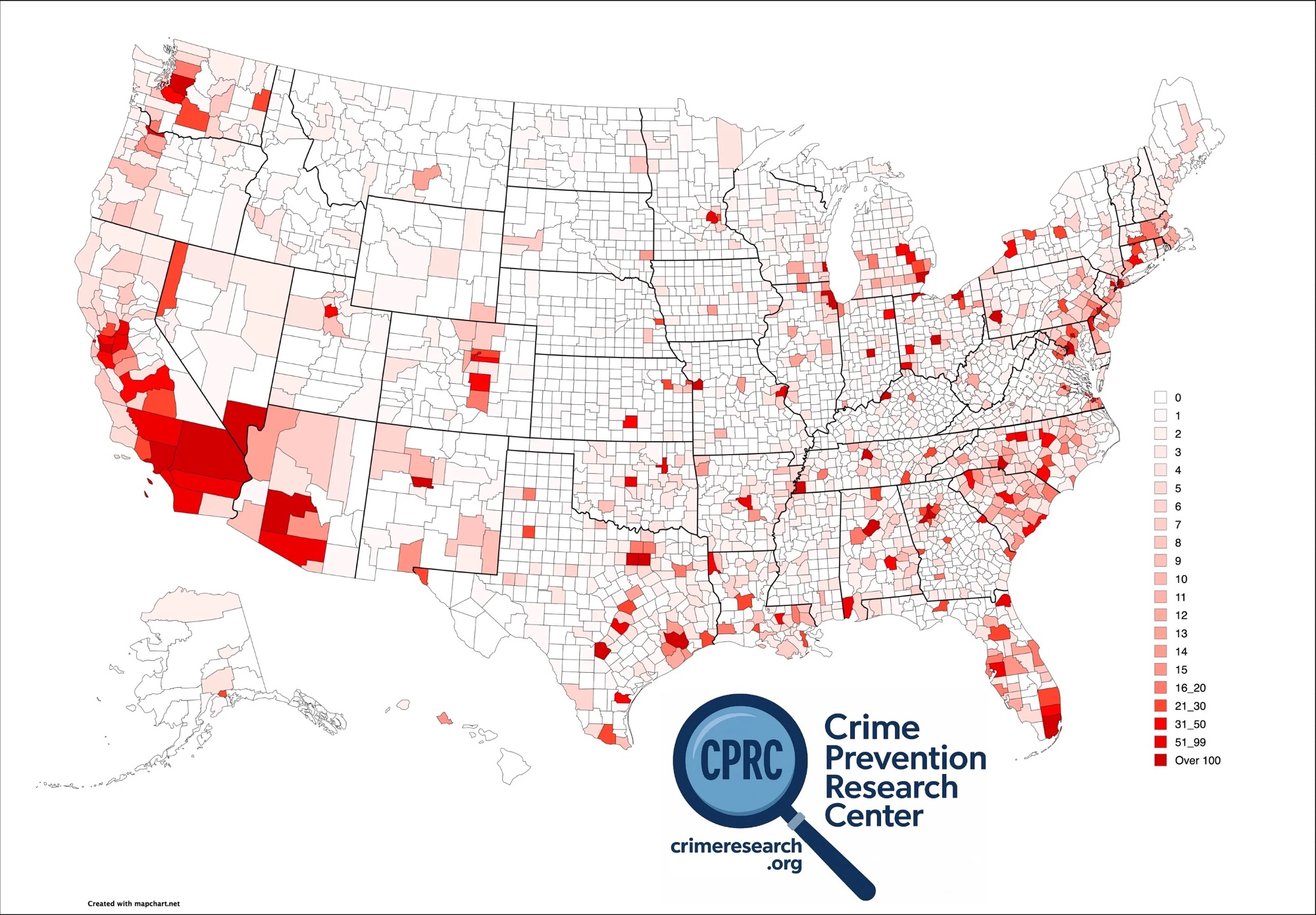
When headlines talk about national crime trends, it is easy to assume that safety—or the lack thereof—is spread evenly across the map. But a study by Dr. John R. Lott Jr. at the Crime Prevention Research Center demonstrates that violent crime in America remains hyper-concentrated.
According to the report, murders in the U.S. remained heavily concentrated in 2024, with the worst 2% of counties continuing to see murder levels near their 2020 peaks.
Texas—with its massive footprint, diverse population, and 254 distinct counties—provides a clear case study of how this hyper-concentration plays out in practice.
The National Picture: The 2% Reality
The findings reinforce a long-standing pattern in American crime statistics:
- A Concentrated Core: A tiny fraction of counties (just 2%) accounts for the vast majority of homicides across the nation.
- Persisting Peaks: Despite broader discussions of national crime fluctuations, homicide numbers in these top 2% high-crime areas have remained stubbornly near their elevated 2020 peaks.
- The Peaceful Majority: Over half of all U.S. counties register zero murders in a given year, and the vast majority register very few.
Zooming in on the Lone Star State: A Tale of 254 Counties
Texas is the second-largest state by both area and population, but when you break down homicide metrics across its 254 counties, the “statewide average” quickly becomes misleading. Texas neatly mirrors the macro findings of the report: violent crime isn’t a statewide wave—it’s concentrated in specific urban hubs.
The High-Volume Urban Hubs
A handful of populous Texas counties fall directly into that top tier of national murder concentrations:
- Harris County (Houston): As the most populous county in Texas, Harris County consistently ranks among the top counties nationally for absolute murder totals. Specific neighborhoods within the Houston metro area drive the overwhelming majority of these numbers.
- Dallas County: Mirroring trends in major metropolitan centers, Dallas County accounts for a disproportionate share of the state’s total violent crime.
- Bexar County (San Antonio) & Tarrant County (Fort Worth): These major urban centers round out the primary areas where homicide counts remain clustered.
Within these counties, the concentration narrows even further: violence is rarely spread across an entire county, but rather localized within specific zip codes and census tracts.
The Peaceful Majority
Outside of the major metropolitan clusters, the narrative changes dramatically:
- Rural & Suburban Safety: The vast majority of Texas’s 254 counties report either zero murders or single-digit numbers annually.
- The “Zero-Murder” Belt: Dozens of west, central, and panhandle counties experience years at a time without a single homicide.
Key Takeaway: A Texan’s statistical exposure to violent crime depends far less on the state they live in and far more on the specific block or county they call home.
Why County-Level Context Matters for Policy
Understanding the heavy concentration of crime has major implications for policy, law enforcement, and public perception:
- Targeted Resources Over Blanket Solutions: Broad, statewide mandates often fail to address the root causes of localized violence. Effective intervention requires placing resources directly into the specific neighborhoods driving high violence rates.
- Avoiding Misleading Narratives: Framing crime as a uniform statewide problem creates unnecessary fear in low-crime rural and suburban counties while diluting focus away from urban neighborhoods that urgently need police presence and community support.
- Focusing on Repeat Factors: Highly concentrated violence is often tied to specific micro-factors, such as localized gang activity, drug market enforcement, and a small pool of repeat offenders.
The Bottom Line
The 2024 data serves as a strong reminder: America does not have a broad, uniform crime problem—it has a localized crime problem. In Texas, where 254 counties stretch across vastly different landscapes, acknowledging this reality is the first step toward smart, targeted public safety solutions.
Train hard. Train smart. Train safe.
AI assisted research and editing. Human verified and finalized.
Leave a Reply